
The Evolution of Mass Multiplayer Gaming: From Chaos to Coordination in High-Player-Count Arenas
Explore the best large-scale multiplayer games like Fortnite and Battlefield, where massive player counts redefine chaotic fun and strategic depth. Discover how these titles masterfully blend social interaction with emergent gameplay in epic 64 to 100+ player arenas, offering unforgettable, dynamic experiences.
The digital battlefield has expanded far beyond the cramped corridors of early online shooters. As of 2026, the very definition of a "large" multiplayer match has been redefined, with technology now seamlessly supporting arenas where 64, 100, or even hundreds of players collide. This isn't just about cramming more names onto a scoreboard; it's a fundamental shift in game design, creating ecosystems of chaos, emergent strategy, and social interaction on a scale once reserved for dedicated MMOs. What does it feel like to be one soldier in a hundred, and how have developers harnessed this potential for both mindless fun and tactical depth?
Fortnite: The Limitless Sandbox
Topping any modern list is almost a given, but Fortnite's dominance is a testament to its foundational philosophy: limitless creativity within a massive player base. Its biggest advantage remains an incredibly deep sandbox. The game transcends its battle royale roots, offering a platform where community creativity has spawned everything from high-speed racing circuits to meticulous tactical shooter clones. The core experience is "dumb, goofy, and fun," as described, but its longevity stems from empowering its massive community to build their own experiences. With a free-to-play model (outside its original Save the World mode), it has become a global social space where 100-player lobbies are just the starting point for imagination.
The Battlefield Legacy: War on a Grand Scale
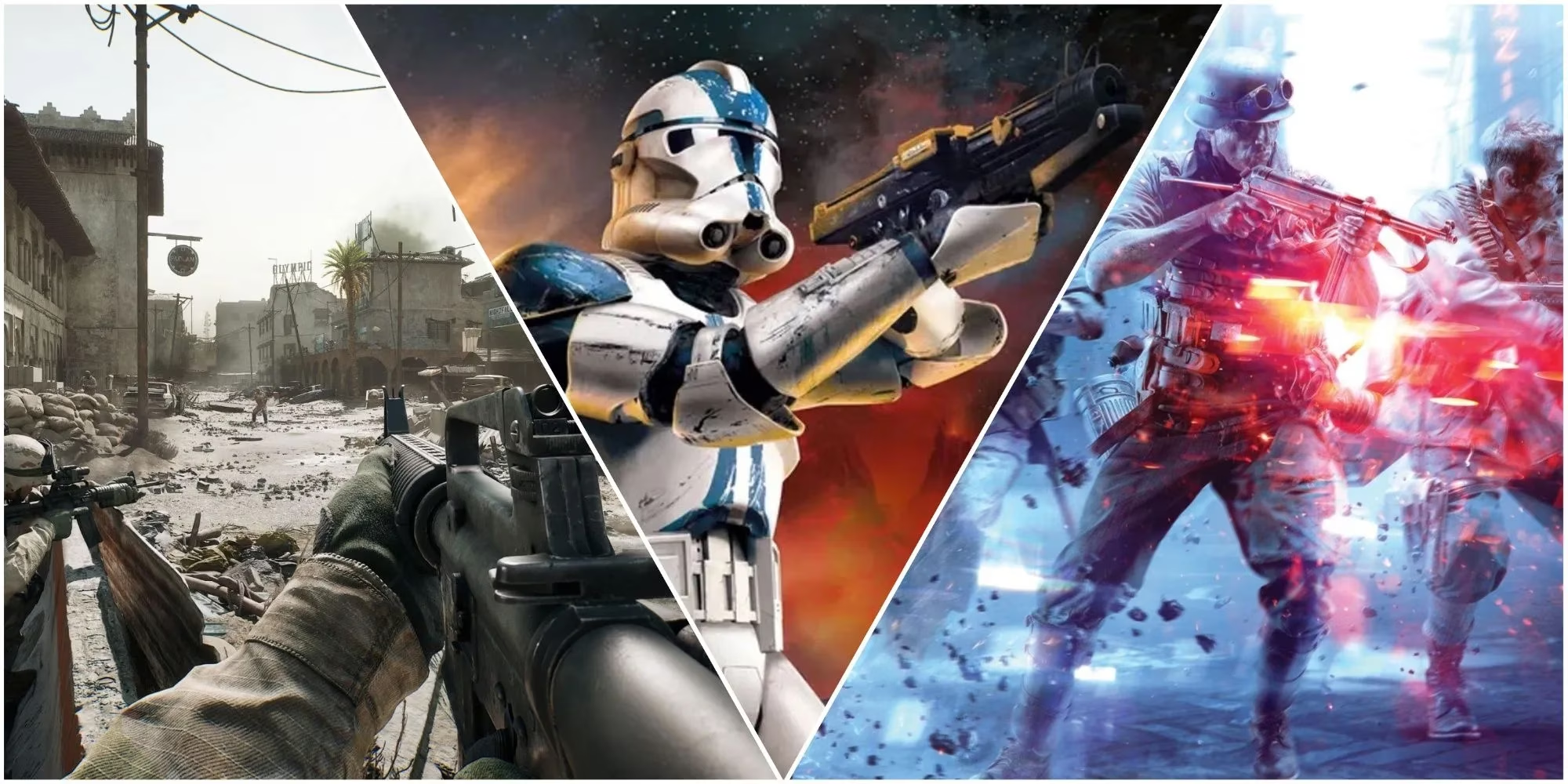
The Battlefield series, particularly Battlefield 1 and Battlefield 5, wrote the blueprint for large-scale, class-based warfare. These entries streamlined the formula for maximum spectacle. Battlefield 1 delivered concise, atmospheric World War I combat where 32-player teams fought for control across crumbling landscapes. Its successor, Battlefield 5, intensified the struggle by making resources like ammo and health scarce and introducing fortification building—allowing players to reshape the dynamic 64-player battlefield in real time. Both games mastered the art of "only in Battlefield" moments, where collapsing buildings and vehicle mayhem created unforgettable stories within the grand 32 vs. 32 chaos.
New World: The MMO Reimagined for Mass Gatherings
While MMOs have always been "massive," New World distinguishes itself by making massive gatherings the core gameplay loop. Unlike traditional theme park MMOs where endgame content is gated behind small group instances, New World's world is alive with collective action. Why grind a dungeon with five friends when you can join a hundred-strong "chest run" convoy, fighting through respawning zones for loot? How about facing a holiday-themed world boss like a gigantic turkey with a small army of fellow players? The pinnacle is its 50 vs. 50 territorial wars, which have tangible economic consequences for the game's regions, making every participant feel like part of a living, breathing world conflict. It's social gaming on a truly massive scale.
Star Wars: Battlefront (Classic): Immersion Over Balance
The original Star Wars: Battlefront games (2004-2005) hold a special place for proving that large-scale multiplayer can be about pure, cinematic immersion rather than competitive balance. The joy wasn't in a perfectly fair fight; it was in feeling like an extra in a Star Wars movie. The games were gloriously unbalanced—being chased down by a Jedi who was six times faster and harder to hit was absurdly fun. The mechanics encouraged this: heroes healed by dealing damage, so waves of regular soldiers were rewarded for sacrificing themselves to whittle down a powerful foe. This created battles that looked and felt epic, where everyone played a role in the spectacle, even if that role was "blaster fodder." It was 64 players sharing a collective fantasy.
Squad: The Chill Military Simulator
On the more serious end of the spectrum lies Squad, a 50 vs. 50 military simulator that emphasizes communication and logistics over twitch reflexes. Is it complicated? Not really, unless you volunteer to fly the helicopters. The game's genius is in its player-driven frontlines. Spawn points aren't static flags; they are Forward Operating Bases (FOBs) built and supplied by players. A team's success hinges on truck drivers running ammo resupply routes under fire. If the logistics fail, soldiers spawn with empty magazines. Despite its realistic framework, the community is famously chill, more interested in coordinated teamwork and occasional goofing around than hyper-competitiveness. It's proof that large-scale warfare can be deliberate, strategic, and surprisingly relaxing.
Delta Force: The Modern Contender
As a relatively new entry, Delta Force (circa 2025) has emerged as a compelling alternative in the large-scale military shooter genre. While superficially compared to others, it refines the formula with smarter design choices. Its weapon customization is deeper and more accessible, and its operators (character classes) are designed explicitly to encourage team play and coordination. Developer Team Jade demonstrates a deep appreciation for what makes large-scale combat work: clear roles, balanced map design, and a pace that allows for both tactical play and explosive moments. For players seeking a modern, polished take on 64-player warfare with a tone that leans into action-movie heroics, it has firmly established itself as a top-tier destination.
The State of Mass Multiplayer in 2026
The evolution is clear. We've moved from simply adding more players to designing entire game ecosystems around them. The best high-player-count games in 2026 offer more than just bigger battles; they offer different kinds of experiences:
| Game | Player Scale | Core Experience | Key Innovation |
|---|---|---|---|
| Fortnite | 100+ | Creative Sandbox | User-Generated Content & Mode Diversity |
| Battlefield 1/5 | 64 | Cinematic All-Out Warfare | Destructive Environments & Class Warfare |
| New World | 100+ (World) / 100 (War) | Social MMO Sandbox | Mass PvE Events & Player-Driven Economy |
| Star Wars: Battlefront | 64 | Cinematic Immersion | Asymmetric, Fantasy-Fulfilling Gameplay |
| Squad | 100 | Tactical Military Sim | Player-Driven Logistics & Communication |
| Delta Force | 64+ | Modern Military Shooter | Streamlined Teamplay & Customization |
Ultimately, the push for higher player counts asks a fundamental question: does more always mean better? The answer, as these games show, is a resounding it depends. More players can mean unparalleled chaos and spectacle, the birth of spontaneous communities, or the need for meticulous coordination. The technology is now a canvas, and the best games are those that understand what they want to paint on it—whether it's a silly cartoon masterpiece, a grim war documentary, or an epic fantasy tapestry woven by thousands. The future isn't just about supporting more players; it's about giving all those players a meaningful reason to be there together. 🎮
Comments