
PaRappa the Rapper’s Best Shot at a Comeback Is Inside Fortnite
Fortnite Festival and PaRappa the Rapper showcase Fortnite's evolution into a dynamic metaverse blending rhythm games and music culture.
As a professional gamer who has watched Fortnite morph from a battle royale anomaly into an ever-expanding metaverse, I can’t help but marvel at its collision course with music culture. Over the past few years, Epic Games has masterfully woven rhythm and collaboration into the DNA of its flagship title. The 2023 acquisition of Harmonix — the legendary studio behind Rock Band — was the clearest signal yet. It gave birth to Fortnite Festival, a rhythm-based mode that resurrects the plastic-instrument era without the plastic. Suddenly, I found myself tapping along to licensed tracks while my squad danced in absurd emotes, and it felt like a fever dream that actually made sense. 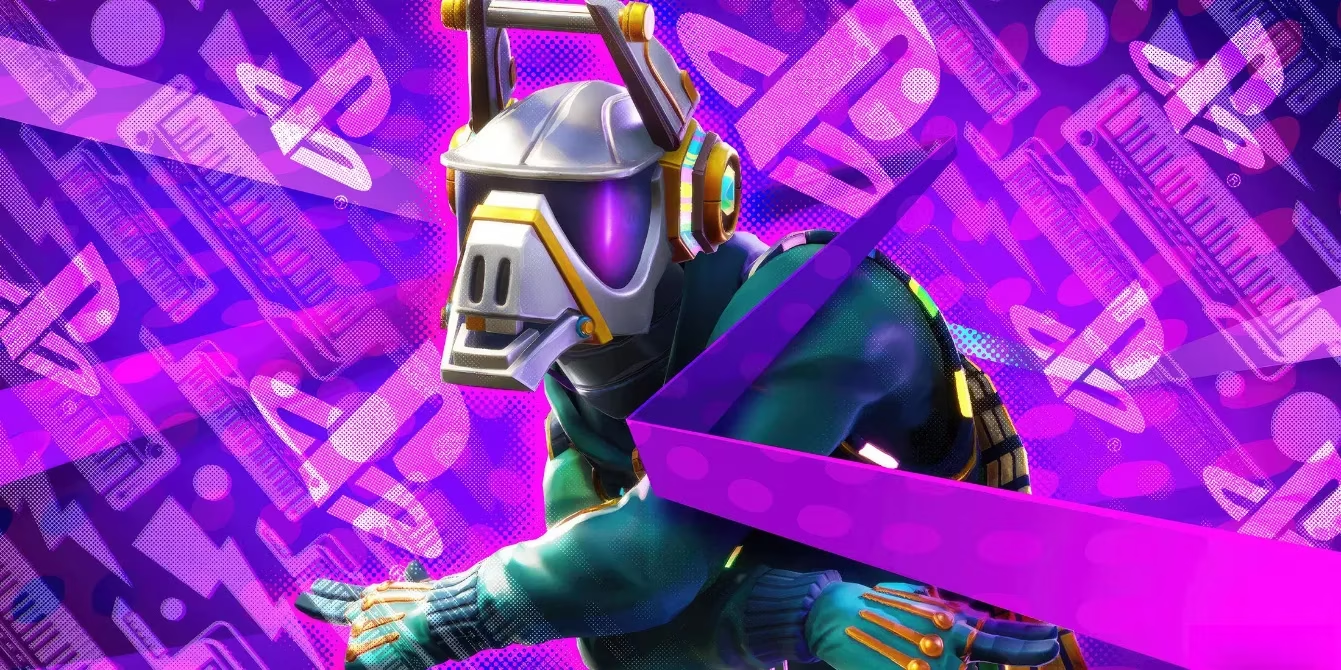
But here’s the thing: Fortnite is no longer just a game. It’s a platform — a churning cauldron of experiences where players can bounce between battle royale, Lego survival, racing, and virtual concerts featuring real-world superstars. This metaversal sprawl has given the game an almost limitless capacity for reinvention. While some critics dismiss the constant crossover stream as lazy nostalgia bait, I see something far more potent. Fortnite has become a defibrillator for dormant IP. Through its lens, characters and concepts that would otherwise be shelved forever can find a bizarre second life. And in 2026, with the rhythm genre experiencing a subdued renaissance, there’s one series that deserves this treatment more than any other: PaRappa the Rapper.
The original PaRappa the Rapper landed on the PlayStation in 1996 and practically midwifed the home-console rhythm genre. I was just a kid bobbing my head to its flat, paper-thin characters, trying to nail the call-and-response raps about karate, cooking, and driving lessons. Its charm was ineffable — a blend of quirky humor, unforgettable tunes, and an eccentric graphic style that looked like a children’s pop-up book brought to life. Yet, despite its cult status, the franchise has been comatose since its 2001 sequel. No remasters, no reboots, not even a digital re-release on modern consoles. The absence stings because PaRappa’s DNA still pulses through contemporary hits like Ubisoft’s Just Dance series. So why hasn’t it returned? Traditional game development demands massive budgets, and a classic rhythm game — no matter how beloved — is a hard sell in a market obsessed with sprawling open worlds. A standalone $60 PaRappa revival would be a gamble most publishers wouldn’t take. But inside Fortnite, the risk evaporates.
Imagine logging into Fortnite and selecting an option called “Rap Battles” or “Rhythm Dojo.” Instead of guns, you match beats against opponents online in a mode that channels PaRappa’s core DNA. The mechanics are already there — Fortnite Festival proves that layered note highways and scoring work seamlessly within the engine. But a PaRappa crossover wouldn’t just be a reskinned Festival. It would need its own identity. Think seasonal chapters where the protagonist raps through increasingly absurd scenarios, each one unlocking new cosmetic items. I would be rushing to earn backblings shaped like Chop Chop Master Onion’s head or a loading screen styled like a crude construction-paper cutout. The game could even introduce a competitive leaderboard for freestyle combos, merging Battle Royale’s social hooks with PaRappa’s rhythmic charm.
A huge part of PaRappa’s enduring appeal is its visual language — jagged lines, flat textures, and deliberately jerky animations that shouldn’t work but absolutely do. In a era where Fortnite’s polished, cartoony sheen has been accused of becoming the “default” safe look for live-service games, importing PaRappa’s style would be a jolt to the system. I can picture the initial loading screen: a stark, two-dimensional stage that clashes beautifully with Fortnite’s 3D lobby. Epic wouldn’t even need to fully abandon its own aesthetic — a hybrid approach could be the real triumph. Imagine 3D Fortnite characters rendered with cel-shading and paper-like edges, moving with that signature PaRappa stiffness. It would feel uncanny at first, maybe even divisive, but that’s exactly the point. It would spark conversations and pull in players who have grown weary of visual homogeneity. Respecting the original fanbase means risking something aesthetically bold, and Fortnite has the scale to absorb that risk.
Critics might argue that a crossover cheapens PaRappa’s legacy, turning a beloved mascot into just another skin in the item shop. But I’d counter that a curated, dedicated mode does the opposite. It introduces the character to millions of youngsters who never touched a PlayStation 1. My little cousin already knows Master Chief and God of War only through Fortnite, and I suspect those franchises haven’t suffered from the exposure. For PaRappa, the bar is even lower — it literally has nothing to lose. A well-executed Fortnite integration could act as a pilot season, proving market demand and potentially paving the way for a standalone remake or even a new entry.
Sony and Epic already have a collaborative track record, and by 2026 the gaming landscape is more receptive than ever to experimental fusions. A PaRappa the Rapper revival through Fortnite wouldn’t just be a nostalgia grab; it would be a statement about how we preserve interactive art. Instead of letting classics languish in licensing hell, we can recontextualize them within living platforms. I’d happily spend an evening challenging friends to a rap battle under the neon glow of a Fortnite sky, my character belting out “Kick! Punch! It’s all in the mind!” while a digital sun dips behind absurd landmarks. That’s the promise of the metaverse done right — not a replacement for traditional gaming, but a museum that still lets you touch the exhibits.
Comments